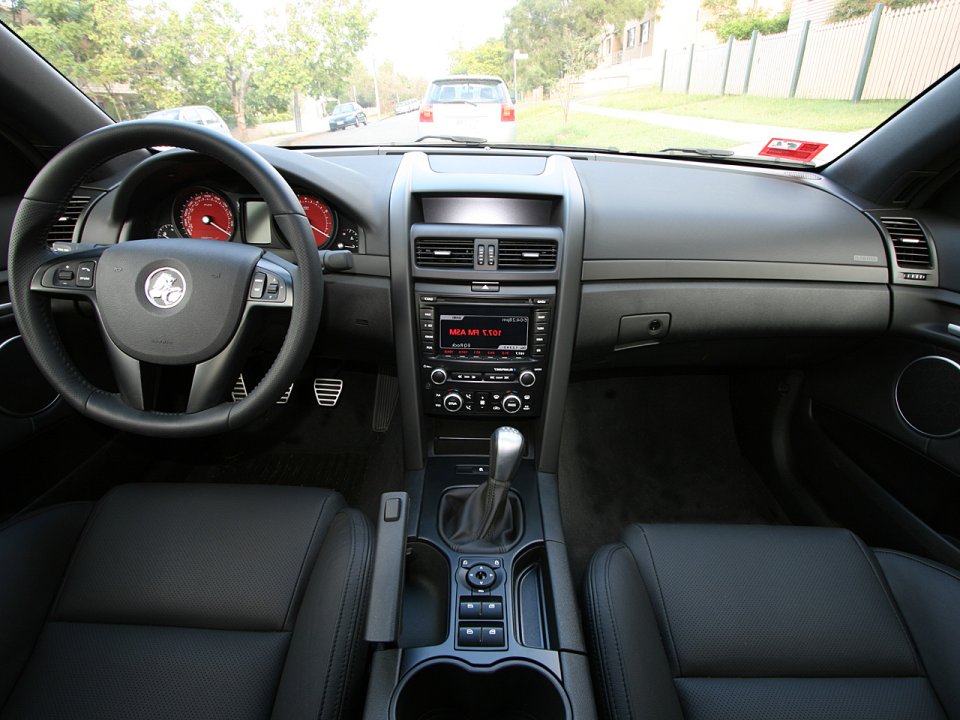
The Holden Commodore is an automobile manufactured since 1978 by the Holden subsidiary of General Motors (GM) in Australia, and, formerly, in New Zealand. In the mid-1970s, Holden established proposals to replace the long-serving Kingswood nameplate with a smaller, Opel-based model. Opel continued to provide the basis for future generations until the launch of the fourth generation in 2006, which deployed an Australian developed platform. Initially introduced as a single sedan body style, the range expanded in 1979 to include a station wagon, with utility and long-wheelbase Statesman/Caprice derivatives following in 1990. The foundations for a revived Monaro coupé, four-door Crewman utility, and all-wheel drive Adventra crossover were provided by the now discontinued third generation architecture. From 1984, Holden began branding the flagship Commodore model as Holden Calais; the Holden Berlina and Holden Ute followed in 1988 and 2000, respectively. These were known previously as the Commodore Berlina and Commodore utility. Rivalry has come predominantly from the Ford Falcon—also locally-built. Prior to the 1988 onwards second generation Commodore, the Holden was positioned a full class below the full-size Falcon. To a lesser degree, competition has also come from Toyota, and previously Mitsubishi Motors, with their mid-size cars. Between 1989 and 1997, Toyota retailed a Toyota Lexcen version of the second generation Commodore. With the introduction of generation three in 1997, Holden broadened the Commodore's export plans. Since the late-1990s, Commodores have been sent abroad as the Chevrolet Lumina and Chevrolet Omega, with Vauxhall VXR8 sales beginning in 2007. Versions have also been previously exported in the mid-1990s to Southeast Asia as the Opel Calais, and to North America between 2007 and 2009 as the Pontiac G8.

Introduced in October 1978, the Holden VB Commodore development covered a period with the effects of the 1973 oil crisis still being felt. Hence, when Holden decided to replace the successful full-size HZ Kingswood with a new model line, they designed the new car to be smaller and more fuel efficient. Originally, Holden looked at developing a new WA Kingswood, however, this project was later dismissed. With no replacement in development, Holden looked towards Opel for providing the foundations of the VB, basing it loosely on the four-cylinder Rekord E bodyshell with the front grafted on from the Opel Senator A. This change was necessitated to accommodate the larger Holden six- and eight-cylinder engines. Holden also adopted the name "Commodore" from Opel, which had been using the name since 1967. Opel went on to use Holden’s Rekord-Senator hybrid as a foundation for its new generation Commodore C, slotting in between the two donor models. The Holden VN Commodore of 1988 and subsequent second generation models took their bodywork from the larger Opel Senator B and new Opel Omega A. However, this time, the floor plan was widened and stretched; now matching the rival Ford Falcon for size. Continuing financial woes at Holden meant the wider VN body was underpinned by narrow, carry-over VL chassis components in a bid to save development costs. In the VN and succeeding models, the Commodore Berlina became known simply as the Berlina. The range expanded in 1990 to include a utility variant, given the model designation VG. This was built on a longer-wheelbase platform that it shared with the station wagon and luxury VQ Statesman limousine released earlier in the year. During this time, the rival Ford EA Falcon was plagued with initial quality issues which tarnished its reputation. Buyers embraced the VN Commodore, helping Holden to recover and post an operating profit of A$157.3 million for 1989. The team at Wheels magazine awarded the VN Car of the Year in 1988: the second Commodore model to receive this award.

With the VT Commodore of 1997, Holden looked again to Opel in Germany for a donor platform. The proposal was to take the Opel Omega B and broaden the vehicle’s width and mechanical setup for local conditions. In the early days, Holden considered adopting the Omega as is, save for the engines and transmissions, and even investigated reskinning the existing VR/VS architecture. Later on, the VT bodywork spawned a new generation of Statesman and Caprice limousines, and even went as far as resurrecting the iconic Monaro coupé from the 1960s and 1970s. Launched in 2006 after GM's 2003 abandonment of their last European rear-drive sedan, the Opel Omega, the VE is the first Commodore model designed entirely in Australia, as opposed to being based on an adapted Opel-sourced platform. Given this and high public expectations of quality, the budget in developing the car reportedly exceeded A$1 billion. Underpinned by the new GM Zeta platform, the VE features more sophisticated independent suspension all round and near-even 50:50 weight distribution, leading to improved handling. Engines and transmissions are largely carried over from the previous VZ model. However, a new six-speed GM 6L80-E automatic transmission was introduced for V8 variants, replacing the old four-speed automatic now relegated to base models. The design of this new model included innovative features to help minimise export costs, such as a symmetrical centre console that houses a flush-fitting hand brake lever to facilitate its conversion to left-hand drive. Internationally, the Commodore is again badge engineered as the Chevrolet Lumina and Chevrolet Omega, along with its new export market in the United States as the Pontiac G8 (discontinued as of 2010 along with the Pontiac brand).
 Holden Torana TT36 Show Up
 Exotic Holden Torana TT36 In Pink Color
 Holden Torana TT36 Shows Detail
 Holden Torana TT36 Engine Detail
 Holden Torana TT36 Exotic Interior
 Holden Torana TT36 Audio Stereo
 Holden Torana TT36 Speedometer
 Holden Torana TT36 Excellent Interior
 Holden Torana TT36 Hatchback